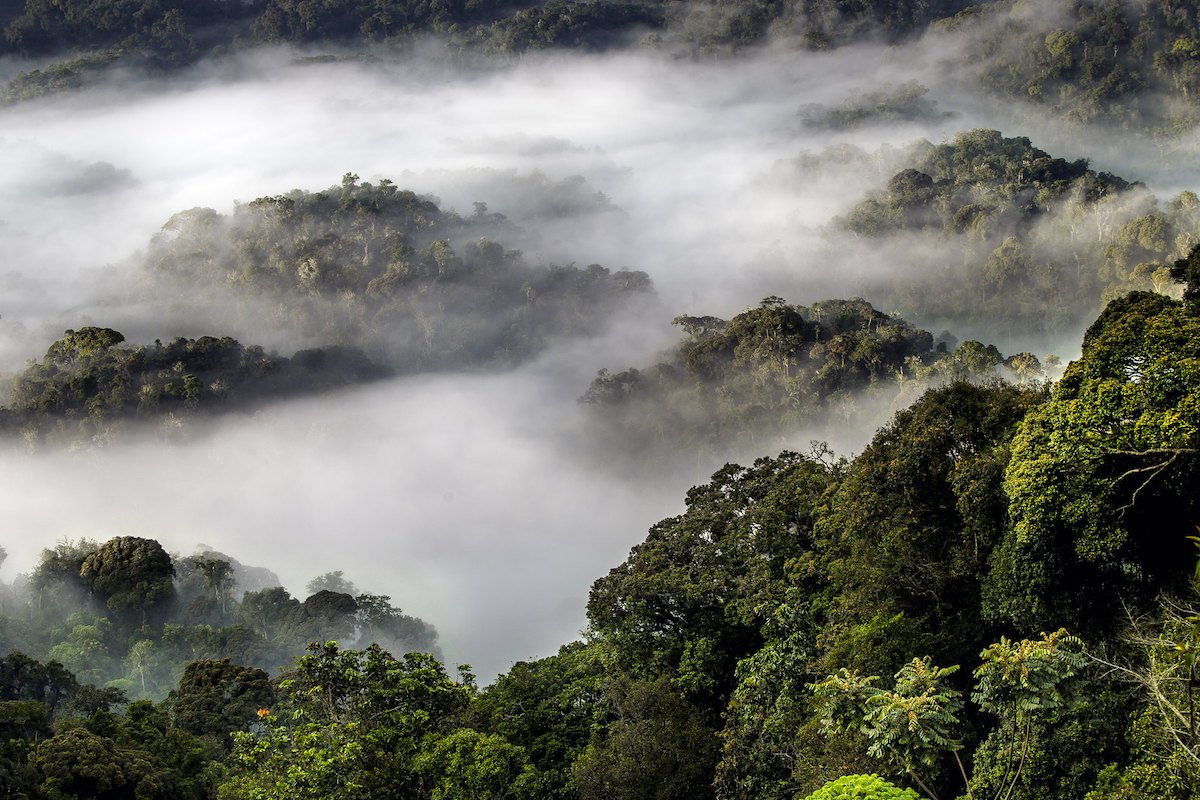

Nyungwe National Forest, also known as Nyungwe National Park, is a vast montane rainforest located in southwestern Rwanda, on the border with Burundi and close to Lake Kivu and the Democratic Republic of Congo. Covering about 1,019 square kilometers, it is one of the largest and most well-preserved rainforests in Africa and sits in a region known for exceptional biodiversity. The park was declared a national forest reserve in 1933 and became a national park in 2004. In 2023, Nyungwe was inscribed as a UNESCO World Heritage Site, underscoring its global ecological importance.
Geography and Biodiversity
Nyungwe is situated in the Albertine Rift, a western branch of the East African Rift Valley. It is home to more than 1,100 plant species—including 140 orchid types and 240+ trees—as well as 345 bird species and 85 mammal species, of which 13 are primates. Notable resident animals include chimpanzees, Colobus monkeys, L’Hoest’s monkeys, leopards, owl-faced monkeys, and over 29 Albertine Rift endemic bird species. The forest forms part of the watershed dividing the Congo and Nile river basins and provides 70% of Rwanda’s water supply. Its terrain comprises rainforest, bamboo, grasslands, swamps, and bogs, with its highest peak being Mount Bigugu at 2,921 meters.
Tourism, Conservation, and Community Impact
Nyungwe National Park is famous for eco-tourism. Key attractions include chimpanzee trekking, bird watching, extensive hiking trails, and the only canopy walkway in East Africa. Since the early 2000s, sustainable tourism development—supported by conservation organizations and the Rwandan government—has focused on community involvement and environmental education. Tourism has become a vital source of income, supporting local communities through jobs and revenue-sharing schemes and encouraging conservation. The park employs buffer zones and partners with African Parks to further its ecological health and economic sustainability, seeking to balance the needs of local populations with conservation goals. Challenges such as poaching, illegal mining, and encroachment have been reduced through management and outreach, but ongoing vigilance is required for ecosystem protection.
Conclusion
Nyungwe National Forest is a cornerstone of Rwanda’s natural heritage, offering world-class biodiversity, ecotourism, and tangible benefits for both the environment and rural communities.