
Rwanda Varsity League Finals: The Sporting Experience Rwanda Is Quietly Building
An experience worth travelling for.
The Rwanda Varsity League finals in Gisagara and Huye showed that university sport in Rwanda is becoming more than competition. Through student energy, packed venues, emerging talent, and community pride, the league is quietly building a new sporting experience worth watching.
For many people, Rwanda is known for its breathtaking landscapes, mountain gorillas, clean cities, and remarkable economic transformation. Increasingly, however, another story is beginning to unfold — one driven by the energy, ambition, and talent of its university students.
Though only in its inaugural season, the Rwanda Varsity League is rapidly becoming one of the country's most exciting sporting platforms. Bringing together universities from across the nation, the competition is doing more than crowning champions; it is creating a culture where education, sport, entertainment, and national pride come together.
Long before the final whistle, the atmosphere in Gisagara and Huye already told the story. Students were singing, flags were moving, and every attack on the court or field was welcomed like a national moment. For one weekend, university sport in Rwanda was no longer only about competition — it became a celebration of youth, talent, and belonging.


Where Sport Meets Celebration
Long before the first whistle, the atmosphere around the venues told its own story. Students arrived in full force to support their colleges and universities, and every corner echoed with chants, laughter, and friendly rivalry as supporters transformed the stadiums into a festival rather than simply a sporting venue.
That energy was on full display when EAUR Kigali edged out host-region favourites RP Huye 74–68 in a tightly contested women's basketball final at the RP Huye campus court, and again when Mount Kigali University's second-half surge — capped by goals from captain Martin Ufiteyezu, Christian Ingabire, and Jacques Rekeraho — turned a goalless football final into a 3–0 statement win at Kamena Stadium. Men's basketball delivered one of the most one-sided results of the finals: Rwanda Polytechnic (RP) Huye overwhelmed University of Rwanda (UR) Nyarugenge 81–45, a 36-point margin that reflected complete control from start to finish.


Handball belonged entirely to UR Huye. The university completed a clean sweep of the discipline, winning both the men's and women's titles — the only university to achieve a double title across any sport in the league's inaugural season. It's a result that points to real depth in UR Huye's handball programme, built on strong coaching and squad development across both categories rather than reliance on a single standout team.


Volleyball produced two distinct storylines in its debut Varsity League season. In the women's category, RP Kigali were dominant, sweeping UR Remera in straight sets (3–0) to claim the title without dropping a set along the way. The men's final was a tighter contest: East Africa Christian College (EACC) held off a determined UR Huye side 3–2, a result that showed the growing competitiveness of men's university volleyball beyond the traditionally stronger programmes.

More Than University Sports
What makes the Rwanda Varsity League unique is that every athlete competing is first and foremost a student. Behind every sprint, save, defensive or offensive play, spike, and point scored are countless hours spent balancing lectures, assignments, examinations, and training sessions. Their commitment reflects not only athletic ability but also discipline, resilience, and determination.
The football final offered a clear example of that discipline in action: after a goalless first half in which EAUR Kigali's defence held firm, MKU — coached by Jean de Dieu Zabayo — reorganised at the break and produced a dominant second-half display to seal the title, a tactical composure that mirrors the balancing act these student-athletes manage all season.
That combination gives the competition a purpose beyond winning trophies. It is becoming a platform where young people develop leadership, teamwork, and excellence — qualities that extend far beyond the field of play. For many athletes, this is where future professional careers begin.

Building Rwanda's Sport for Future Generations
Around the world, university sport has become a powerful engine for developing talent. Competitions such as the NCAA in the United States have produced Olympic champions, professional athletes, and global sporting icons, while attracting thousands of passionate supporters every season.
The Rwanda Varsity League is steadily building its own identity in the same mould — creating an environment where universities compete with pride, supporters travel to follow their teams, and young athletes gain the experience needed to compete at even higher levels. The presence of Ministry of Sports Permanent Secretary Candy Basomingera among the dignitaries at the finals in Huye and Gisagara, alongside Vice Mayor for Economic Development Denise Dusabe, signals the level of institutional backing the league is attracting early in its life.

For international visitors, matchday became a gateway to local tourism, culture, and community — a chance to discover Rwanda through its people, hospitality, and shared love of competition. As the league continues to grow, it has the potential to become one of East Africa's premier university sporting events and an important pathway for Rwanda's future sporting success.
A Tradition in the Making
As the final whistle echoed through Gisagara and Huye, one thing became clear: the Rwanda Varsity League is not simply growing; it is building a tradition. One season at a time, one university at a time, and one unforgettable atmosphere at a time, Rwanda is creating a university sports culture that deserves to be seen, experienced, and celebrated.
This is a sports economy still being built in real time, on the backs of students as disciplined in the classroom as they are on the court, pitch, and field. For those who have never experienced the Rwanda Varsity League, that may be the perfect reason to make the journey.
Discover More With KMT Discovery. To discover Rwanda beyond the usual images, follow KMT Discovery for weekly stories on sports, culture, tourism, education, and the new generation shaping the country's future.
- The New Times (Kigali), “Mount Kigali University crowned 2025/26 Varsity League football champions,” by Dylan Mugenga, published 29 June 2026; syndicated via AllAfrica.com.
- Attendance of Ministry of Sports Permanent Secretary Candy Basomingera at the Huye/Gisagara finals, as reported by The New Times / AllAfrica (29 June 2026).
- The X account of Rwanda Varsity League, @VarsityleagueRw
Liberation Cup 2026: The Final Whistle That Honoured a Nation
Police WVC and REG VC crowned champions as Kigali closes the volleyball season on Kwibohora weekend.
In the years following the 1994 Genocide against the Tutsi, sport quietly became one of the tools through which Rwandan society began rebuilding trust. Mixed teams, community leagues, and national competitions gave people from different backgrounds a shared reason to stand side by side.
Football, volleyball, and cycling were used deliberately by clubs, schools, and government programmes as spaces where cooperation could take root, one match at a time. It was a slow, unglamorous process, but it worked in ways few outsiders expected.
That investment paid off far beyond the court. A country many observers had once written off as a failed state has instead built one of Africa's most admired sporting reputations — hosting the UCI Road World Championships, sponsoring Arsenal's shirt sleeve, and staging polished, well-attended domestic tournaments such as the Liberation Cup. Each fixture adds another chapter to Rwanda's story of recovery and, as this year's tournament shows, the story is still being written in front of live crowds at Petit Stade.
Police Women's Volleyball Club retained the Liberation Cup for a fourth straight year, while Rwanda Energy Group VC dethroned defending champions Police VC in the men's final. The 2026 edition, held from 1 to 3 July at Petit Stade, Amahoro Complex in Kigali, brought the national volleyball season to a close on the eve of Kwibohora, Rwanda's Liberation Day.
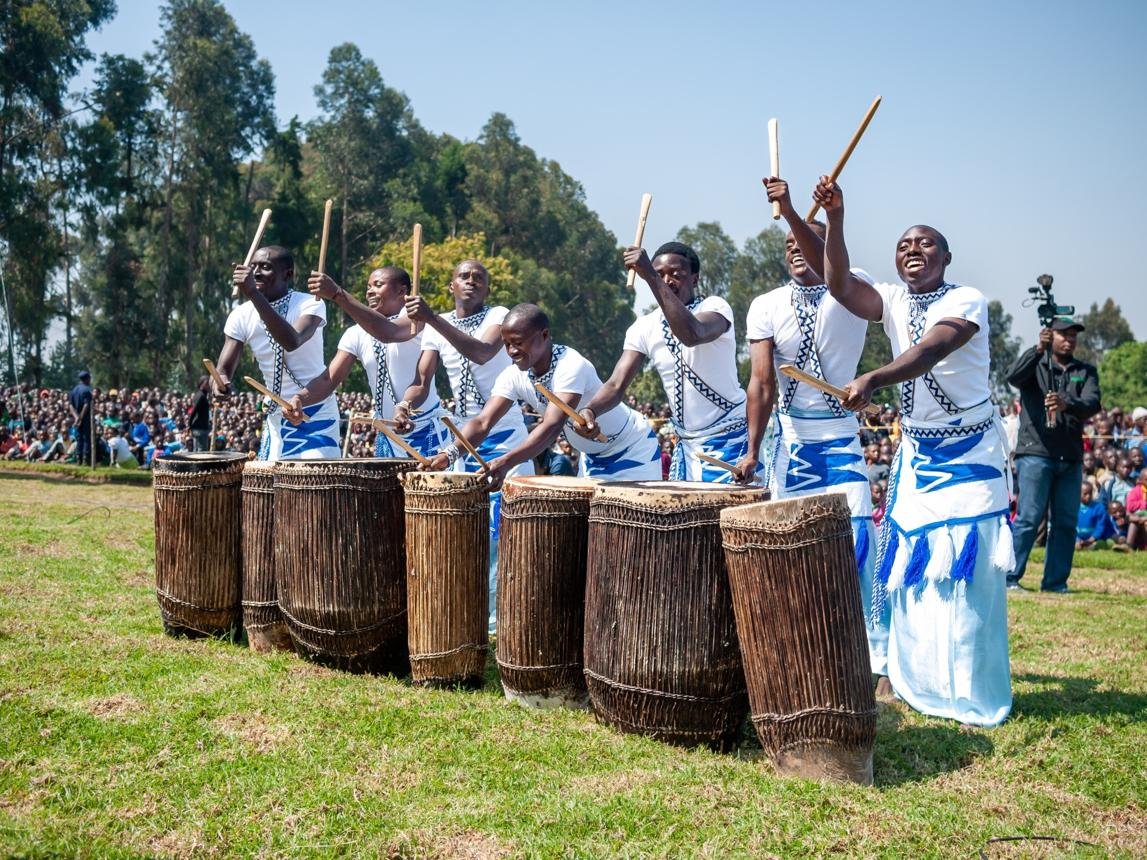
Long before the final whistle, the atmosphere at Petit Stade already told the story. Drums rolled between rallies, supporters in club colours filled the stands, and every spike, block, and dive was met with a roar that had little to do with sport alone. For one weekend in Kigali, volleyball became something larger than a competition — a shared act of remembrance, pride, and celebration.
A Tournament Built on Memory
The Liberation Cup is organised annually by the Fédération Rwandaise de Volleyball (FRVB) to commemorate Kwibohora, 4 July — the day the Rwandan Patriotic Army entered Kigali in 1994 and brought the genocide to a halt. It is the final fixture on the national volleyball calendar, and clubs treat it as both a closing statement on their season and a tribute to the liberators whose sacrifice the day honours.
This year's edition fielded five men's clubs — Police VC, APR VC, Kepler VC, REG VC, and Gisagara VC — and four women's clubs: Police WVC, APR WVC, Kepler WVC, and RRA WVC. Police arrived as defending champions in both categories, and the tournament unfolded across three days: pool-stage matches on 1 July, semi-finals on 2 July, and bronze and gold medal matches on 3 July. On paper, it looked like a formality for the defending champions. On court, it turned out to be anything but.
Where Competition Meets Celebration
From the opening serve, Petit Stade carried the charged, communal energy that Liberation Cup weekend is known for. Families arrived early to claim seats, off-duty officers cheered alongside civilians, and university-age fans turned each set into a call-and-response of song and rhythm — a reminder that in Rwanda, sport and national memory are rarely far apart.
The women's final set the tone. Police WVC and APR WVC, the country's two dominant women's sides, met for the title in a contest that swung on fine margins throughout. Police won the first set 29–27 after trading advantage points deep into extra play, then closed out the match 25–21 and 26–24 to complete a 3–0 sweep and a fourth consecutive Liberation Cup crown.
“Winning it once is an achievement. Winning it four years running, on this particular weekend, means something different to us as a team.”
A POLICE WVC PLAYER, REFLECTING ON THE CLUB'S TITLE DEFENCEChampions Forged in Rivalry
If the women's final belonged to continuity, the men's final belonged to change. REG VC ended Police VC's reign as men's champions in a match that swung through four tightly contested sets, eventually closing out victory 25–18, 20–25, 25–22, 25–23 to lift their first Liberation Cup title in recent seasons. The result signals a squad capable of matching the country's traditional powerhouses on the biggest occasions.
Elsewhere, Gisagara VC edged APR VC 3–2 to claim third place in the men's competition, one of the weekend's closest contests. No third-place playoff was held in the women's category, with Kepler WVC and RRA WVC exiting at the semi-final stage.
Whether REG VC's win marks the start of a genuine shift at the top of Rwandan men's volleyball, or simply one golden weekend, is a question only next season can answer — and one KMT Discovery will be watching closely.
A New Sports Experience for Rwanda
Beyond the scoreline, the Liberation Cup fits into a broader pattern KMT Discovery has tracked across Rwanda's sporting calendar this year: a growing willingness to fuse competitive sport with national identity, tourism, and civic occasion. Much as the Tour du Rwanda and the 2025 UCI Road World Championships turned cycling into a platform for showcasing the country, the Liberation Cup uses volleyball to anchor a moment of collective remembrance in a setting of genuine sporting quality.
It raises a bigger question we will keep returning to in this series: as more of these fixtures draw international eyes, how much further can Rwanda stretch sport as both a healing tool at home and a calling card abroad? The next few tournaments on the calendar may already be answering that.
- Police WVC have now won four consecutive women's titles at the tournament.
- REG VC's win ends Police VC's men's title defence and reshapes the domestic pecking order.
- The tournament is increasingly cited as a model for linking sport with national commemoration and tourism.
PARTICIPATING CLUBS
Men: Police VC, APR VC, Kepler VC, REG VC, Gisagara VC.
Women: Police WVC, APR WVC, Kepler WVC, RRA WVC.
Voices from the Stands
For many in the crowd, the significance of the weekend went beyond the trophies — a chance to combine celebration with reflection, gathering with friends and family in a setting where sport becomes a shared language.
“For us, this tournament is not only about who wins. It is about coming together as Rwandans, on this particular weekend, to celebrate what our country has built.”
A SUPPORTER AT PETIT STADE, AMAHORO COMPLEXConclusion: A Season Closed, A Story Continued
The 2026 Liberation Cup delivered exactly what Kwibohora weekend has come to promise: high-quality volleyball, full stands, and a reminder that Rwanda's sporting calendar is never entirely separate from its national story. Police WVC leave Petit Stade as the country's most dominant volleyball side of the decade so far, while REG VC's men's title suggests next season's league race is more open than it has been in years.
Whichever way the rivalries break next season, one thing is settled: for Rwandan volleyball, the road to July now runs through Liberation Cup weekend and through Petit Stade, where trophies and national memory continue to share the same court.
What REG VC do with this breakthrough, whether Police WVC can stretch their run to five titles, and which club steps up to challenge them both — those are the storylines KMT Discovery will be following as the new season takes shape.
Follow KMT Discovery to explore Rwanda differently through its people, talents, destinations, and untold stories — weekly, on sports, culture, tourism, education, and the new generation shaping the country's future.
- Ground Sports, “Police WVC Win Fourth Consecutive Liberation Cup Title,” 4 July 2026. ground-sports.com/police-wvc-win-liberation-cup-title
- Ground Sports, “Police Chase Back-to-back Liberation Cup Titles As Volleyball Season Ends,” 2 July 2026. ground-sports.com/liberation-cup-2026
- The New Times, “REG VC, Police WVC win 2026 volleyball Liberation Cup,” 4 July 2026. newtimes.co.rw/article/37097